

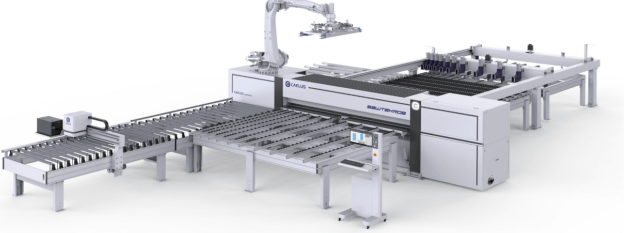
In the fiercely competitive furniture manufacturing industry, the cutting process within the production workshop often dictates the critical pace—and ultimate success—of the entire production line. If your factory still relies on traditional manual sliding table saws to process mountains of panel materials, you may be hemorrhaging significant profits and precious time.
To meet the demands of massive order volumes and extremely high dimensional precision requirements, the industrial sector has provided the ultimate answer: the beam saw. Today, we will take a deep dive into exactly what this machine—hailed as the "beast of panel cutting"—is used for, the role it plays in modern funiture manufacturing, and how the adoption of top-tier cutting equipment can enable a geometric leap in production capacity.
What is a Beam Saw?
To understand its purpose, one must first understand its construction. A beam saw (often referred to as an electronic panel saw or computerized panel sizing saw) is a piece of heavy-duty industrial equipment designed specifically for high-throughput panel cutting.
It derives its name from its signature structural feature: the "pressure beam." During the cutting process, this heavy, robust crossbeam acts like a hydraulic clamp, firmly pinning down the panels to be cut. Subsequently, a saw carriage—housing both the main saw blade and a scoring saw blade—emerges from beneath the worktable and glides rapidly along high-precision linear guides to execute the cut in an instant.
Unlike traditional panel saws, which require an operator to manually push the material back and forth, this machine requires the operator only to place the panels in the loading zone (or utilize an automated loading system); the machine then automatically grasps, positions, clamps, and completes the cutting process.
Table 1: Beam Saw vs. Standard Panel Saw Machine
| Feature | Beam Saw | Standard Panel Saw Machine |
| Material Clamping | Heavy-duty automatic pressure beam | Manual or simple clamping cylinders |
| Cutting Volume | Mass production, stack cutting enabled | Single sheet, low to medium volume |
| Automation Level | High (CNC controlled, auto-feeding) | Low to Medium (Manual pushing) |
| Precision | Extremely high and consistent | Dependent on operator skill |
| Footprint | Large (requires significant floor space) | Compact to Medium |
The Core Applications of Beam Saws in Furniture Manufacturing
What specific tasks does this industrial behemoth actually handle within a factory setting? Its core applications can be summarized in the following key areas:
1. High-Speed, Large-Scale Stack Cutting
This is the beam saw's "killer feature"—the capability that truly sets it apart from ordinary equipment. When processing high-volume, standardized orders (such as office desk tops or standard wardrobe shelves), it can simultaneously cut three to five panels stacked vertically on top of one another. This means that, within the same cutting cycle time, its output is several times greater than that of standard cutting equipment. This exceptionally high throughput serves as the lifeline for large-scale panel processing centers.
2. Precision Control of Dimensions
Modern furniture manufacturing demands a level of precision that borders on the exacting. If cutting dimensions deviate by more than 0.2 millimeters, subsequent automated edge banding machines cannot achieve a perfect fit; similarly, hole positions at CNC drilling centers will become misaligned, ultimately resulting in unsightly gaps during furniture assembly. The absolute rigidity of the pressure beam system—combined with the precise positioning capabilities of servo motors—ensures that every cut panel is dimensionally flawless, features a mirror-smooth cut surface, and is completely free of chipping.
3. Maximizing Material Utilization
These machines are not merely hardware giants; they are also software sages. They are typically equipped with advanced nesting and optimization software. Engineers need only input a list of required panel dimensions, and the software can calculate the most material-efficient cutting path within seconds. For a manufacturing sector characterized by slim profit margins, boosting panel utilization rates from 85% to 95% translates directly into tangible financial savings.
4. Flexible Beam Saws: Handling Complex Orders
With the rise of whole-house custom furnishing, a "high-mix, low-volume" production model has become the market mainstream. Traditional heavy-duty beam saws often prove cumbersome when faced with frequent order changeovers. In response, the industry has evolved to introduce "flexible beam saws." These machines retain the inherent stability of the pressure beam system but are equipped with a more intelligent, independent dual-pusher system and offer lightning-fast response speeds. They can seamlessly switch between processing batch orders and handling customized one-off pieces, perfectly aligning with the production rhythms of modern custom furniture manufacturing.
Putting Advanced Cutting Technology into Practice: An Analysis of the Caelus Panel Saw Series
Once the critical importance of cutting equipment is understood, selecting a reliable equipment manufacturer becomes a top priority. Among the multitude of panel saw brands on the market, Caelus stands out thanks to its profound understanding of intelligent manufacturing.
Caelus does not limit itself to the manufacture of single, isolated machines; instead, it offers a comprehensive suite of cutting solutions ranging from entry-level models to highly flexible, fully automated systems. For panel processing enterprises striving for peak efficiency, Caelus’s equipment designs are perfectly tailored to address the specific pain points and operational challenges faced by modern manufacturing facilities. Shared Technical Advantages of Caelus Equipment
Heavy-Duty Frames and Servo Drives:All machines in the Caelus series feature high-rigidity structural designs, paired with high-precision servo or linear drive systems. This ensures that the machine body remains rock-steady—even during prolonged, high-speed operation—and that cutting precision consistently meets the highest industry standards.
Dual-Saw Anti-Chipping Technology: Equipped with an ingenious combination of a main saw and a scoring saw. The scoring saw first cuts a very shallow groove into the underside of the panel, followed by the main saw completing the cut. This design completely eliminates the persistent problem of edge chipping often encountered when processing composite materials, such as melamine-laminated panels.
**Intelligent Connectivity Capabilities:** Caelus equipment does not operate as an isolated information silo. These machines can seamlessly integrate with a factory's MES (Manufacturing Execution System), supporting automated production scheduling and automatic label printing. Furthermore, they can interface with intelligent automated storage and retrieval systems (AS/RS) to enable unmanned material calling and loading operations.
Table 2: Caelus Panel Saw Machine Portfolio
| Series | Target Manufacturing Scenario | Key Technical Highlights |
| Pilot S3 / S5 | Entry to Medium automated custom furniture | Heavy-duty frame, smart cutting control, high-density clamps |
| Aurora S6 | High-automation smart factories | Linear motor drive, laser deformation detection, integrated labeling |
| Aurora S8 | High-volume industrial mass production | Rear-loading capable, independent dual-pusher, high-speed routing |
| SawTekRob 5 | Unmanned flexible manufacturing cells | Robotic handling, automatic turning, multi-process integration |
As illustrated in the table above, whether you are a medium-sized factory requiring the flexibility to handle custom orders, or a large-scale manufacturing hub requiring 24/7 full-capacity operation, Caelus offers cutting solutions precisely tailored to your needs. In particular, its high-end series possesses the throughput and stability required to confidently handle even the most demanding production environments.
How to Choose the Right Cutting Equipment for Your Factory?
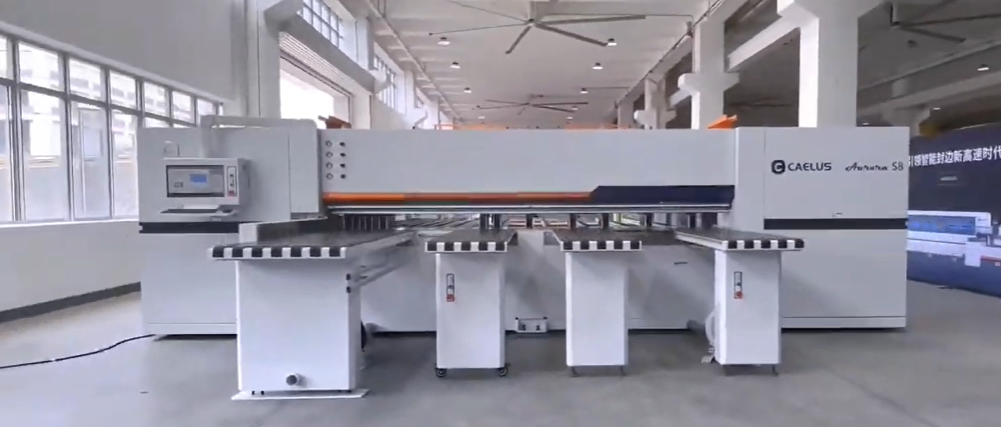
Faced with the vast array of equipment available on the market, making the right investment decision requires careful consideration of the following key points:
Evaluate Your Order Profile: If your factory primarily produces high-volume, standardized commercial furniture, a heavy-duty, rear-loading automated cutting saw is your optimal choice. If, however, you specialize in whole-house custom cabinetry—where orders are highly fragmented—then a panel saw featuring ultra-fast job changeover speeds and advanced cutting optimization software will yield the highest return on investment.
Consider Space and Logistics: High-efficiency cutting equipment is often substantial in size. Prior to purchase, you must carefully plan the material feeding workflow and designate a buffer zone for cut panels. If space is limited, a compact, front-loading machine may be a more suitable option for your facility.
Software Ecosystem Compatibility: While hardware establishes the minimum capacity of your production line, software determines its maximum potential. Ensure that the equipment you select integrates seamlessly with your existing design and cut-listing software (such as Cabinet Vision, Pytha, etc.) to prevent errors caused by manual data re-entry.
FAQ
Q1: What is the primary application scenario for a beam saw?
Beam saws are primarily used in furniture manufacturing for large-scale, high-precision panel cutting. By utilizing a heavy-duty pressure beam for clamping and a high-speed saw carriage for movement, they can simultaneously cut multiple stacked panels in a single pass. Consequently, they serve as core equipment for large-scale panel processing factories aiming to achieve standardized mass production and boost production capacity.
Q2: What is the fundamental difference between a beam saw and a standard panel saw?
A standard panel saw typically requires an operator to manually push the sliding table to feed the material; it is better suited for cutting single panels or small-batch processing, and places certain physical and experiential demands on the operator. In contrast, a beam saw employs an automated pressure beam system to firmly clamp the panels, while a saw carriage located beneath the machine automatically executes the cut at high speed. Consequently, its level of automation, cutting precision, and overall throughput are far superior to those of a traditional panel saw machine.
Q3: Are flexible beam saws suitable for companies specializing in whole-house custom cabinetry?
Absolutely. While traditional heavy-duty cutting equipment tends to be geared toward large-volume production runs, modern flexible beam saws perfectly combine the absolute stability of a pressure beam with the agility of intelligent layout optimization software. They are often equipped with advanced technologies—such as independent dual pushers—that enable them to respond rapidly to the demands of high-mix, low-volume custom cutting tasks, thereby drastically reducing changeover times while maintaining high precision.
Q4: Can upgrading to a high-end panel saw machine truly save money for a factory?
Yes. Although the initial investment for high-end equipment is higher, its built-in layout optimization software maximizes material utilization, resulting in substantial long-term savings on material costs. Furthermore, precise cutting virtually eliminates chipping and dimensional errors, significantly reducing the scrap rate and manual rework costs associated with subsequent edge banding and drilling processes. This translates into an exceptionally high long-term return on investment.
Conclusion
In summary, as the very heart of modern panel processing, this type of highly efficient cutting equipment has long since transcended the simple act of "cutting wood." These machines serve as guardians of precision, expert material optimizers, and—above all—the primary engine driving the automated workflow of the entire factory. In an era of razor-thin margins, every rejected panel caused by chipping and every moment of idle machine time—resulting in costly delays—quietly erodes your company's profits. Equipping your furniture manufacturing business with a high-performance cutting system as exceptional as the Caelus series is not merely an act of responsibility toward product quality; it represents the most critical investment you can make in your company's future competitiveness.