

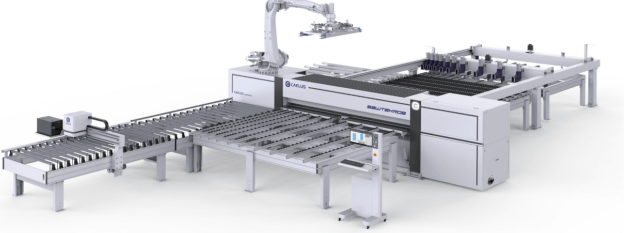
Machine upgrades mark critical turning points for furniture manufacturers. Booming custom furniture market raises higher requirements for processing precision and efficiency. Factory owners often struggle to choose between flexible CNC panel saws and high-output beam saws during capacity expansion.
The selection matters far more than technical specs, as it shapes future production modes. Improper choice causes slow small-batch switching or capacity bottlenecks in mass production. Grasping core differences between the two saws defines production ceiling and long-term operating costs.
Being the initial core working procedure, panel saw selection requires careful consideration. This comparison helps you make wise investment decisions.
What is a CNC Panel Saw?
Definition and Core Features of CNC Panel Saws
CNC panel saws are digital manufacturing devices driven by computer numerical control. Equipped with accurate servo systems, they control saw blade travel and positioning, distinct from traditional manual saws.
Flexibility is its key strength. It manages complicated cutting tasks effortlessly for uniform or varied sized boards. Its flexible high-precision cutting fits the multi-style and small-batch production trend of modern furniture industry.
Typical Application Scenarios of CNC Panel Saws
It acts as core equipment for custom furniture and cabinet production.Its automatic layout optimizes material usage for variable-size customized orders. Advanced models cut wood, acrylic, fireproof boards and more.
Caelus Pilot S3 sets reliable industry standards. As an entry-level saw, it features intelligent control and robust frame, satisfying high precision demands of small and medium factories.
What is a Beam Saw?
Definition and Structural Characteristics of a Beam Saw
Beam saw features a sturdy beam as its core structure, with the saw head moving linearly along the beam.
It realizes automatic feeding, clamping and high-speed cutting. Boasting stable clamping performance, it supports stack cutting of multiple boards, delivering outstanding stability and working speed.
Advantages of Beam Saws in Industrial Production
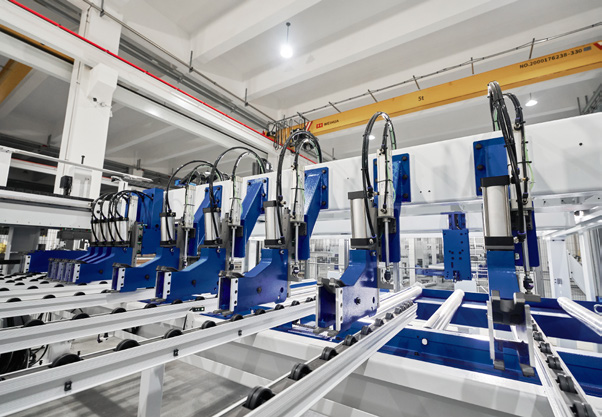
In the field of industrial Panel Saws, the Beam Saw is the undisputed king.
Mass production: Suitable for handling standard-sized engineering orders.
High speed: The saw carriage driven by a linear motor is extremely fast.
Production line integration: It usually serves as the core of a Panel Saw line, connecting automatic warehousing and edge banding lines.
Caelus's Aurora S8 is designed for this purpose. As a high-capacity Panel Saw with rear loading, it supports a double-layer stacking auxiliary device, allowing loading while processing, ensuring the machine never stops.
Core Differences Between CNC Panel Saws and Beam Saws
To provide a clear overview, we conduct an in-depth comparison from three dimensions: structure, efficiency, and cost.
Structure and Working Principle
CNC Panel Saws emphasize control, compensating for the limitations of mechanical structure through software-optimized paths. Beam Saws, on the other hand, emphasize "structural rigidity," ensuring stability at high speeds through a massive clamping beam and linear guides.
Production Efficiency and Automation
Automated Panel Saws perform differently in different scenarios. For custom orders, CNC saws excel in quick changeovers; for engineering orders, Beam Saws excel in cutting multiple panels at once.
Cost and Return on Investment
Table 1: CNC Panel Saw vs. Beam Saw Comparison
|
Feature |
CNC Panel Saw |
Beam Saw |
|
Primary Strength |
Flexibility & Optimization |
Throughput & Stack Cutting |
|
Ideal Order Type |
High Mix, Low Volume (Custom) |
Low Mix, High Volume (Batch) |
|
Cutting Precision |
High (Servo Controlled) |
Very High (Heavy Duty Beam) |
|
Initial Investment |
Moderate |
High |
|
Space Requirement |
Medium |
Large (Requires loading area) |
|
Skill Required |
Software operation skills |
Process management skills |
How to Choose the Right Panel Saw for Different Furniture Manufacturing Scenarios?
Custom Furniture vs. Mass Furniture Production
If you are involved in whole-house custom furniture manufacturing, with highly fragmented orders and hundreds of different sizes to handle daily, then a high-performance front-loading Panel Saw like the Caelus Pilot S5 is the best choice. Its independent dual-push system and intelligent flexible work clamps allow you to handle complex orders with ease.
Conversely, if you are manufacturing office furniture for export or standard cabinets, with large order volumes and uniform sizes, then a Beam Saw is the way to go.
Small and Medium-Sized Factories vs. Industrial-Grade Production Lines
Small and medium-sized factories often have limited budgets and space constraints. CNC Panel Saws have a small footprint, are fully functional, and offer high cost-effectiveness. For industrial-grade production lines, an auto Panel Saw must have the capability to connect to intelligent warehousing systems. Caelus's Aurora S6 is more than just a saw; it can seamlessly integrate into unmanned production lines through laser deformation detection and intelligent labeling systems.
Standalone machine vs. Panel Saw Line Automation Integration
The future trend is the Panel Saw line. Even for a standalone machine, future expandability should be considered. All Caelus models support integration with the StoreTek 5 intelligent panel storage system, meaning that a standalone machine purchased today can be upgraded to an intelligent island tomorrow.
How to Choose the Right Panel Saw/Beam Saw Manufacturer
Choosing machine is essentially choosing a Panel Saw machine manufacturer.
Core Evaluation Criteria
Technical Strength: Is the CNC system mature? Does it possess high-precision servo/linear drive technology? (This is a core technology standard across all Caelus models).
Automation Capabilities: Does the manufacturer understand the entire panel processing process? Can they provide complete line solutions from cutting to edge banding?
Manufacturer Experience
Consider whether the manufacturer has deep expertise in furniture manufacturing. A manufacturer who understands furniture craftsmanship will put considerable effort into anti-chipping designs (such as the main saw + scoring saw combination) and dust removal designs.
Service and Support
When an industrial Panel Saw breaks down, losses are calculated by the minute. The manufacturer's after-sales response speed and spare parts system are crucial.
Table 2: Key Evaluation Metrics for Manufacturers
|
Metric |
What to Look For |
Why It Matters |
|
CNC Maturity |
Proprietary optimization software |
Reduces material waste significantly. |
|
Structural Rigidity |
Heavy-duty steel frame |
Ensures long-term cutting accuracy. |
|
Integration |
MES/ERP compatibility |
Essential for Industry 4.0 upgrades. |
|
Support Network |
Global spare parts availability |
Minimizes unplanned downtime. |
Why Choose Caelus as Your Panel Saw or Beam Saw Supplier?
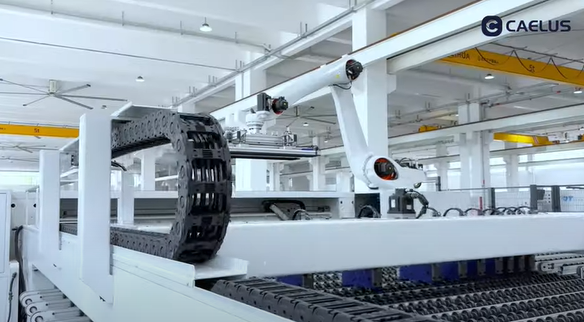
Among numerous brands, Caelus stands out with its systematic solutions.
Focused on Systematic Solutions for Panel Furniture and Panel Processing
Caelus doesn't just sell machines; it provides a complete matrix covering everything from CNC Panel Saws and Beam Saws to complete panel processing lines. From the entry-level Pilot series to the high-end Aurora series, and the SawTekRob 5 flexible cutting unit integrated with robots, Caelus demonstrates powerful capabilities in furniture manufacturing automation.
Core Advantages of Caelus machine in Furniture Manufacturing
High Precision: All series utilize high-rigidity structures and high-precision servo/linear drive systems, achieving industrial-grade cutting accuracy.
Intelligence: Standard equipped with optimization software, supporting automatic path planning and integration with MES.
High Efficiency: Whether it's the independent dual-push system of the Pilot S5 or the high-speed linear drive of the Aurora S8, the goal is to maximize productivity every second.
Caelus' Global Competitiveness as a Chinese Panel Saw Manufacturer
Caelus represents a new height of intelligent manufacturing in China. It breaks the barrier of expensive imported machine, providing world-class performance at a more reasonable cost. For factories looking to upgrade from manual production to automation, Caelus is the ideal partner.
FAQ
Q: Which is more suitable for custom furniture: a CNC Panel Saw or a Beam Saw?
A: CNC Panel Saws are more suitable. Because custom furniture has varying dimensions, the automatic layout and flexible processing capabilities of the CNC system can minimize waste and improve order changeover efficiency.
Q: Are automated Panel Saws suitable for small and medium-sized factories?
A: Absolutely. Entry-level machine like the Caelus Pilot S3, while featuring automation functions, is easy to operate, significantly reducing reliance on skilled workers and improving product consistency.
Q: How to determine if a Panel Saw meets industrial-grade standards?
A: Look at the structure and drive system. Industrial-grade machine typically uses heavy-duty steel frames to absorb vibrations and is equipped with servo or linear motor drives to ensure long-term accuracy, rather than ordinary belt or gear drives.
Q: Are Chinese Panel Saw manufacturers suitable for overseas markets?
A: Yes. Leading brands like Caelus not only offer machine performance comparable to major European manufacturers, but also boast highly internationalized software interfaces and after-sales support, making them extremely cost-effective.
Conclusion: There is no "best," only the "most suitable" Panel Saw.
There is no absolute right answer when choosing a Panel Saw. If your factory prioritizes ultimate flexibility and material utilization, CNC Panel Saws are your best choice; if you face a large volume of standard orders, a Beam Saw will guarantee your production capacity.
Regardless of your choice, always prioritize long-term panel processing capabilities. Caelus provides more than just a machine; it offers a key to intelligent manufacturing. Choosing Caelus means choosing a partner who understands furniture manufacturing processes, automation, and the future.