

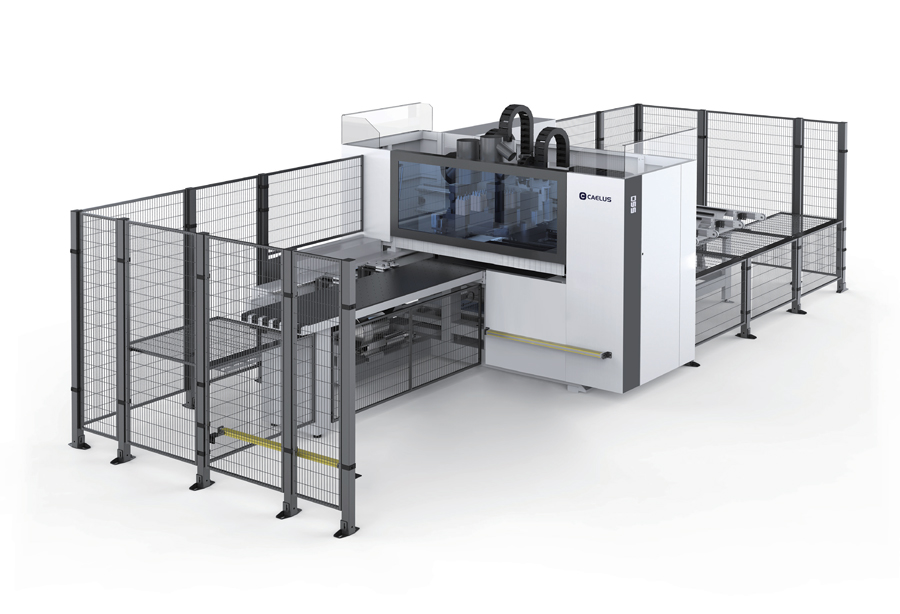
A misplaced hinge hole or connector bore can stop cabinet assembly, create rework, or turn a finished panel into scrap. For furniture manufacturers, the value of a CNC six-sided drilling machine is not simply "more drilling." It is the ability to machine a labelled panel from one reference position, with fewer manual transfers.
A CNC six-sided drilling machine is an automated woodworking machining center that drills the top, bottom, and four edges of a panel in one setup. Depending on its configuration, it can also cut grooves, mill pockets, and machine invisible connectors. It is commonly used for cabinets, wardrobes, office furniture, and other panel-based products.
The useful purchasing question is whether the machine can process your smallest parts, read your production data, hold accuracy across a shift, and connect with the rest of your factory.
How Six-Sided CNC Drilling Works
A typical job moves through five stages:
- Production data is prepared. CAD/CAM or order software generates hole positions, groove paths, tooling instructions, and a part identifier.
- The panel is identified. A barcode or QR code calls the correct program, reducing wrong-file errors.
- The panel is referenced and clamped. Servo-driven grippers position the workpiece while an air-flotation table supports its surface.
- Programmed operations are completed. Upper and lower drill units make vertical holes; horizontal tools reach the four edges. Spindles or optional aggregates machine grooves, pockets, and connectors.
- The panel exits for inspection or the next process. A connected line can pass production status and abnormal-panel warnings downstream.
"One setup" does not mean every tool cuts at the same instant. The sequence depends on hole locations, drill-bank configuration, clamping, and software optimization. The key benefit is that the operator normally does not flip and re-reference the panel manually.
What Changes on the Factory Floor?
Traditional panel drilling may use separate machines for face and edge holes. Every transfer adds handling and another opportunity to load the wrong part, use the wrong reference, or damage a finished surface. A six-sided CNC drilling center consolidates these steps around a digital job file.
This matters in high-mix production. A custom wardrobe factory may process consecutive panels with different dimensions and hole patterns. Barcode-driven machining changes jobs without manual templates and repetitive setup.
The machine cannot fix inaccurate cutting, wrong edge-banding allowances, poor labels, or seriously warped panels. Successful drilling automation begins with clean production data and consistent parts.
A Data-Based Look at the CAELUS D5A
The CAELUS D5A's published workpiece range is 200–2,800 mm long, 50–1,220 mm wide, and 9–60 mm thick. Listed allowable panel unevenness is no more than 0.3 mm. Compare these limits with an export of your actual part list, including drawer components and narrow fillers—not only full-size cabinet sides.
The D5A uses two top drilling blocks with 26 vertical and 18 horizontal tools, plus one bottom block with nine vertical tools. Maximum drill diameter is 35 mm, maximum processing depth is 45 mm, and drill speed is listed at 4,500 rpm, changing automatically to 2,700 rpm for a 35 mm drill in the stated configuration. A five-position automatic tool magazine supports grooving, milling, Lamello-type work, and other connector processes.
The published routing configuration includes a 5.5 kW top spindle adjustable from 12,000 to 18,000 rpm and a 3.5 kW bottom spindle rated at 18,000 rpm. The machine accepts DXF, MPR, and XML data and uses code scanning to identify jobs.
Facility requirements matter as much as tool count. The D5A lists 30.12 kW installed power, 0.6 MPa air pressure, 450 L/min air consumption, and required dust-collection air volume of 9,540 m³/h. Listed dimensions are 7,100 × 3,140 × 2,190 mm, with a gross packing weight of 4,300 kg. Add maintenance access, infeed, outfeed, guarding, and material queues when planning the cell.
See the complete CAELUS automated CNC six-sided drilling solution for configuration details.
Six-Sided Drilling Compared With Other Options
| Solution | Typical capability | Handling | Best fit | Main limitation |
|---|---|---|---|---|
| Six-sided CNC drilling | Top, bottom, four edges; optional routing and grooving | Low after loading | Mixed orders and medium-to-high panel flow | Higher investment and integration needs |
| Side-hole drilling | Primarily edge holes | Depends on face drilling | Simple edge-hole work and limited budgets | Does not replace face machining |
| Multi-boring machine | Repeated fixed hole patterns | Usually higher | Standardized batches | Less flexible for changing designs |
| PTP machining center | Flexible drilling, routing, and grooving | May require repositioning | Complex parts | Cycle time depends on tool path |
| CNC nesting machine | Cutting plus mainly face drilling and routing | Edge drilling remains separate | Optimized cutting and labelling | Not a six-edge drilling solution |
A six-sided machine is most compelling when job variety, manual flipping, misidentification, or multiple drilling stations limit production flow.
How to Verify Accuracy and Real Output
A brochure tolerance is not enough. Accuracy depends on the frame, motion system, tooling, clamping, panel condition, software, and measurement method. NIST's machining measurement research likewise treats measurement as part of process and product-quality management, not merely a machine label.
Before buying, run a factory acceptance test with your files and materials:
- Include the smallest, largest, and most common parts.
- Process 20–50 varied panels continuously, not one demonstration piece.
- Time the cycle from barcode scan to completed outfeed; maximum axis speed is not cycle time.
- Measure hole position, diameter, and depth with calibrated instruments.
- Inspect breakout and surface damage on your normal materials.
- Test an incorrect label or panel size to verify exception handling.
- Confirm the CAD/CAM formats, postprocessor, and network workflow.
If a supplier states "±0.1 mm accuracy," ask whether that means positioning accuracy, repeatability, or measured hole-position error. Request the sample size, test pattern, material, and measurement report.
Safety and Installation Are Part of Performance
High-speed drills, spindles, clamps, and moving panels require engineering controls and safe procedures. OSHA's general machine-guarding rule requires protection from points of operation, rotating parts, and flying chips. Its woodworking safety guidance also identifies dust, noise, electrical, fire, and explosion hazards. ISO 19085-3:2021 addresses safety for numerically controlled woodworking boring and routing machines.
Local requirements vary, but buyers should review guarding, interlocks, light barriers, emergency stops, lockout, dust extraction, and training before commissioning. A machine waiting for electrical or extraction work produces no return.
How to Choose a Manufacturer of CNC Six-Sided Drilling Machines
The best manufacturer is not necessarily the one with the longest feature list. Look for evidence the supplier can support your production after installation.
Request a test using your parts, a written software-integration scope, utility and layout drawings, training content, warranty exclusions, recommended spares, and service-response commitments. Confirm which functions are standard and which require optional spindles, saws, aggregates, or line equipment.
CAELUS offers D5S, automated single-channel D5A, and dual-channel D6A configurations for different capacity and layout needs. Its portfolio also includes CNC nesting machines, panel saws, edge banders, storage, and automated furniture manufacturing solutions, so drilling can be evaluated as part of the entire panel flow.
FAQ
Q1. Does the machine process all six sides simultaneously?
A: Not necessarily. It processes the top, bottom, and four edges from one setup, but tools follow an optimized sequence based on the program and machine configuration.
Q2. What panels can it process?
A: Typical materials include MDF, particleboard, plywood, and laminated furniture panels. Test your actual coating, density, thickness, and smallest parts because tooling and clamping affect results.
Q3. Can it replace a CNC nesting machine?
A: Usually no. A nesting machine is optimized for cutting sheets and machining panel faces. A six-sided center focuses on drilling finished parts, especially their edges. The processes are often complementary.
Q4. How many panels can it produce per shift?
A: There is no universal number. Output depends on dimensions, hole count, grooves, tool changes, loading, software, and order mix. Request a cycle-time study using representative files.
Conclusion
A CNC six-sided drilling machine can remove manual flipping, consolidate drilling, and support flexible furniture production. Its value depends on fit: part dimensions, data workflow, utilities, service, and verified cycle time.
Send CAELUS your panel sizes, drilling files, materials, daily volume, and current workflow. The application team can recommend a configuration and prepare a test plan based on the parts you actually manufacture.