

For cabinet shops and panel furniture factories, cutting boards is no longer just a machining step. It is where order data, material cost, labor efficiency, labeling accuracy, and downstream assembly all begin to connect. A well-planned CNC nesting workflow helps manufacturers turn digital cabinet designs into accurately cut, labeled, and traceable parts with less manual handling and fewer production errors.
A CNC nesting machine is especially valuable when a factory produces kitchen cabinets, wardrobes, closets, office furniture, or custom panel furniture from MDF, plywood, particleboard, or laminated boards. Instead of cutting one part at a time, nesting software arranges many parts on a full sheet, generates toolpaths, and sends production data to the CNC router machine for wood processing. The result is not only better sheet utilization, but also a more predictable workflow from design to assembly.
Why the Workflow Matters More Than the Machine Alone
Many buyers start by asking about spindle power, tool changer size, or machine price. Those details matter, but they are only part of the decision. In real cabinet production, the bigger question is: can the machine fit your daily workflow?
A strong CNC nesting workflow should solve practical factory problems:
- Too much material waste during manual cutting
- Operators spending too much time marking parts by hand
- Parts mixed between different orders
- Edge banding and drilling stations waiting for correct labels
- Rework caused by wrong part sizes or missing holes
- Difficulty handling batch-one custom furniture orders
Material efficiency is not a small issue, the U.S. EPA reported that wood generation in municipal solid waste reached 18.1 million tons in 2018, and 12.2 million tons of wood were landfilled that year. For furniture manufacturers, reducing avoidable panel waste is both a cost-control issue and a sustainability issue.
Complete CNC Nesting Workflow: From Design to Finished Panels
A practical wood CNC nesting workflow usually follows eight steps.
1. Cabinet Design and Order Data
The workflow starts with cabinet design. A designer or engineer creates the kitchen cabinet, wardrobe, closet, or panel furniture project in design software. At this stage, the factory confirms dimensions, panel materials, thickness, edge banding requirements, hardware positions, grooves, shelf holes, and assembly structure.
For custom furniture, this step is critical because every order may contain different cabinet sizes, colors, board thicknesses, and drilling rules. A small data error at the design stage can become a wrong panel, wrong edge, or wrong hole later in production.
2. BOM and Cut List Preparation
After design approval, the software generates a bill of materials and cut list. A good cut list should include more than length and width. It should include:
- Part name and part ID
- Order number and cabinet number
- Material type and board thickness
- Grain direction
- Edge banding side
- Drilling and grooving data
- Quantity
- Next process information
This is where a CNC nesting workflow becomes different from a basic cnc router machine for wood. A standard router may cut shapes, but a production-oriented CNC nesting machine should carry part information into labeling, cutting, sorting, edge banding, drilling, and assembly.
3. Nesting Optimization
Nesting software places parts onto full-size sheets to improve material yield. The software must consider sheet size, tool diameter, cutting clearance, grain direction, part priority, small-part stability, and machining sequence.
The goal is not simply to "fit as many parts as possible" onto one sheet. In cabinet production, the nesting result must also be safe and practical. Very small parts may shift if they lose vacuum holding too early. Parts with grain direction must be aligned correctly. Panels from the same cabinet may need to stay easy to identify after cutting.
Research on automated panel material management in furniture production shows why data-driven layout and material coordination matter. A BioResources study on automated raw material warehouses for furniture enterprises found that an optimized collation algorithm reduced sheet material collation by 152 sheets, improved pallet utilization by up to 21.6%, and increased storage space utilization by up to 22.7%.
4. Label Printing and Part Identification
For many factories, labeling is where the workflow either becomes efficient or starts to break down. A label should not be treated as a simple sticker. It is the identity card of each panel.
A useful production label may include:
- Order number
- Cabinet or room number
- Part name
- Material and thickness
- Edge banding instruction
- Drilling instruction
- Barcode or QR code
- Assembly sequence
Automatic labeling is especially important for custom cabinet and batch-one production, where many orders may be processed in the same shift. Manual marking can work for small shops, but as output grows, wrong labels and mixed parts can create expensive delays at edge banding, drilling, assembly, and packing.
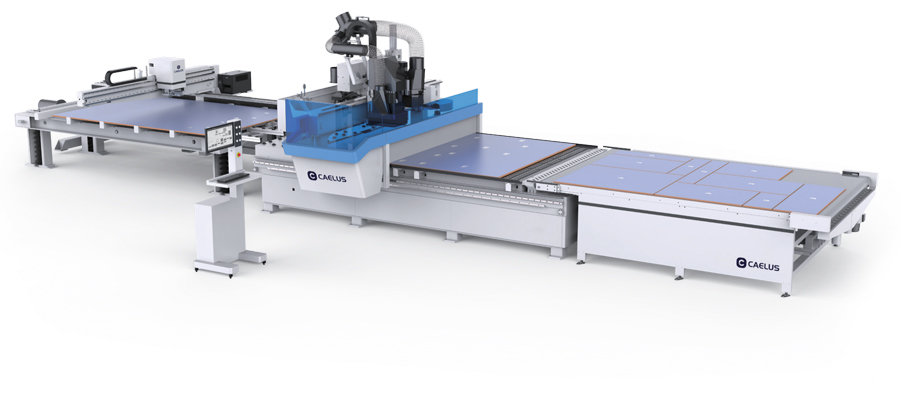
Caelus CNC nesting solutions are designed for this kind of connected panel furniture workflow. The CNC Nesting product page highlights automatic labelling, drilling, grooving, routing, cutting, outfeed, automatic tool changing, controlled vacuum zones, and ERP connectivity for MDF, plywood, particleboard, cabinets, wardrobes, and custom furniture.
5. CNC Cutting, Drilling, Grooving, and Routing
Once the sheet is loaded and vacuum is activated, the CNC nesting machine executes the toolpath. Depending on the configuration, one setup can complete multiple processes:
- Panel contour cutting
- Shelf hole drilling
- Back panel grooving
- Hinge or pilot hole machining
- Pocketing
- Routing
- Marking or engraving if required
This is where machine rigidity, spindle performance, tool quality, vacuum design, and dust extraction affect final part quality. If the frame is unstable or vacuum holding is weak, the factory may see chipped edges, part movement, dimensional errors, or inconsistent cutting quality.
For higher productivity, an ATC CNC nesting machine can change tools automatically. This reduces manual intervention when a job needs different cutters for cutting, drilling, grooving, and routing. For cabinet manufacturers handling mixed orders, automatic tool changing is often more valuable than simply buying a higher-power spindle.
6. Unloading, Sorting, and Offcut Handling
After cutting, finished panels must be removed, checked, and moved to the next process. This step is often underestimated. If operators unload parts without a clear sorting rule, the factory may lose time later searching for panels.
A good sorting process can be organized by order, room, cabinet number, material, or next process. For example, parts that need edge banding can be placed on one cart, while parts that require six-sided drilling can move to another station.
Offcut handling should also be planned. Usable leftover material should be recorded, not simply treated as scrap. Over time, better offcut management can reduce unnecessary board purchases.
7. Edge Banding and Downstream Processing
CNC nesting does not finish the product by itself. Most cabinet panels still need edge banding, drilling, assembly, and packing. That is why the nesting workflow must be planned together with downstream machines.
The cut quality from the CNC nesting machine affects edge banding quality directly. If edges are chipped or inconsistent, the edge bander must work harder to produce a clean finish. Labels also help operators know which side requires edge banding and which edge tape should be used.
For factories producing RTA furniture, wardrobes, and cabinets, six-sided drilling may also be required after nesting and edge banding. Connecting cutting, labeling, edge banding, and drilling into one data-driven workflow helps reduce repeated manual checking.
8. Assembly, Packing, and Traceability
The final goal of wood CNC nesting is not only to cut panels faster. The real goal is to deliver complete cabinet parts to assembly with the right size, right label, right edge, and right holes.
When each part carries a readable label, assembly workers can quickly identify where the part belongs. Missing panels are easier to find. Mixed orders are easier to prevent. Packing becomes more accurate because parts can be grouped by cabinet, room, or customer order.
This is especially important for custom furniture manufacturers. As order variety increases, manual memory and operator experience are not enough. The factory needs a workflow that keeps data attached to every panel.
CNC Nesting Machine vs CNC Router Machine for Wood
A cnc router machine for wood can cut, carve, and shape wood materials. It is useful for general woodworking, signage, decorative panels, molds, and custom parts. A CNC nesting machine is more specialized. It is built for full-sheet panel processing and cabinet production.
| Comparison Point | CNC Router Machine for Wood | CNC Nesting Machine |
|---|---|---|
| Main use | General routing, carving, shaping | Cabinet and panel furniture production |
| Material flow | Individual parts or small batches | Full-sheet processing |
| Software focus | CAD/CAM toolpath generation | Nesting optimization and production data |
| Labeling | Usually manual or separate | Can integrate automatic labeling |
| Best fit | Woodshops with varied jobs | Cabinet, wardrobe, and panel furniture factories |
If your work is mainly decorative routing, a general wood CNC router may be enough. If your factory processes many sheets per day and needs cutting, labeling, drilling, grooving, and downstream tracking, a CNC nesting machine is usually the better production tool.
How to Choose the Right CNC Nesting Configuration
Before asking for a quotation, a buyer should understand the factory's real bottleneck. The right machine depends on production volume, board size, labor structure, software, available space, and future automation plans.
| Factory Situation | Recommended Direction |
|---|---|
| Small cabinet shop upgrading from manual cutting | Standalone CNC nesting machine |
| Growing custom cabinet factory | CNC nesting with automatic labeling |
| Factory with frequent mixed orders | ATC CNC nesting with barcode/QR label workflow |
| Medium-to-large panel furniture plant | Automatic loading, labeling, nesting, outfeed, edge banding, and drilling connection |
| Smart factory planning | ERP/MES-connected automated furniture manufacturing line |
For example, Caelus C3A Automated CNC Nesting with Labelling Solution Line is designed as a one-stop solution for nesting, grooving, drilling, labelling, and outfeed. Its listed configuration includes a 13.2 kW HSK-F63 spindle, optional 12 vertical and 8 horizontal drilling spindles plus grooving saw, 16-position tool changer, 6 automatically controlled vacuum zones, automatic tool length measurement, HMI, and ERP/user software integration.
These specifications matter because they support the workflow, not just the machine brochure. A stronger spindle supports stable panel cutting. A drill unit reduces secondary processing. A tool changer supports multiple operations. Vacuum zoning improves sheet holding. ERP integration helps production data move from order to machine.
Common CNC Nesting Workflow Mistakes
Many factories do not fail because they bought a CNC machine. They struggle because the workflow around the machine was not planned.
Common mistakes include:
- Buying based only on price
- Ignoring automatic labeling needs
- Choosing insufficient vacuum capacity
- Sending incomplete cut list data to the machine
- Treating edge banding and drilling as separate problems
- Not training operators on nesting rules
- Forgetting to plan dust collection and spoilboard maintenance
- Measuring machine output but not downstream bottlenecks
A reliable workflow requires both equipment and process discipline. Operators should check tool condition, vacuum zones, label data, material thickness, spoilboard surface, and cutting sequence before production starts.
Practical Buying Checklist
Before selecting a CNC nesting machine, prepare these details for your supplier:
- What products do you make: cabinets, wardrobes, closets, office furniture, or flat-pack furniture?
- What materials do you process most often?
- What is your standard panel size and thickness range?
- How many sheets do you process per shift?
- Do you need automatic labeling?
- Do you need drilling and grooving inside the nesting process?
- What design or ERP software do you use?
- Do you already have edge banding and drilling machines?
- How much workshop space is available?
- Do you plan to upgrade to automated furniture manufacturing later?
With this information, Caelus can recommend a CNC nesting machine or automated nesting line that fits the actual factory workflow rather than offering a one-size-fits-all machine.
Build a More Predictable Panel Furniture Workflow with Caelus
A CNC nesting machine should help your factory do more than cut panels. It should help your team reduce manual handling, improve part accuracy, control material usage, organize downstream processes, and prepare for future automation.
For cabinet and panel furniture manufacturers, the best investment is not always the most complex machine. It is the configuration that matches your orders, materials, operators, software, and production goals.
If your factory is planning to upgrade from manual cutting, improve custom cabinet production, or build a more automated panel furniture line, Caelus can help evaluate your workflow and recommend the right CNC nesting solution.
Send your panel size, material type, daily sheet volume, current production process, and automation target to Caelus. Our team will help you plan a practical CNC nesting workflow for more accurate, efficient, and scalable furniture production.